
The European Startup, Raidium, uses EuroHPC JU’s supercomputer, Leonardo to build foundational models that could transform medical imaging, helping radiologists work faster and detect diseases more accurately.
Artificial intelligence (AI) has the potential to revolutionise not just radiology but also healthcare, making it more effective, accessible and economically sustainable. For example, AI can empower doctors to scan patients faster, which could mean less stress and more comfort for patients. The technology also has the potential to accelerate advances in diagnostics and drug and vaccine development.
AI even has the potential to improve image quality – which could be key to detecting and prioritising urgent findings and ensuring that patients receive potentially life-saving treatment earlier. For example, according to European Commission President Ursula von der Leyen, AI can further improve patient outcomes by helping detect breast cancer earlier and more accurately, ensuring that more women survive the disease.
But before any of this potential can be put into practice, AI models must first be properly trained – a process that takes both data and time.
That’s because most of the AI tools being used in radiology today follow a ‘one task, one model’ approach, where a separate model is built and validated for every disease, every organ and every imaging protocol, such as computed tomography (CT) and magnetic resonance imaging (MRI).
That’s a lot of models.
“Not only is this approach very slow and expensive, but it’s also a bottleneck for the adoption of AI in hospitals,” says Corentin Dancette, Chief Research Officer at Raidium, a company specialising in AI solutions for radiology.
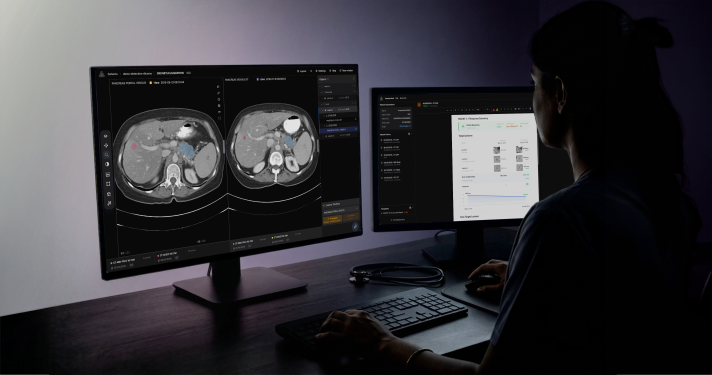
That’s why, with the support of the EuroHPC Joint Undertaking (EuroHPC JU), Raidium is building foundation models for radiology that can be used across clinical tasks and with very little adaptation. A foundation model is a large-scale AI system trained on vast amounts of unlabelled data that serves as a flexible base for many different applications.
EuroHPC supercomputers do the heavy lifting
Training a radiology foundation model on 130 terabytes of imaging data – which was fully anonymised by the Centre Cardiologique du Nord hospital prior to use – wasn’t possible using Raidium’s own hardware. So, the company applied for access time on the EuroHPC Leonardo supercomputer, which it used to run a multi-node, multi-GPU (Graphics Processing Unit) and self-supervised training of its models.
To illustrate just how heavy this data is, consider that the company’s largest model was trained using 32 GPUs non-stop for nearly five days, during which time 475,000 iterations were run.
“Without access to dozens or even hundreds of GPUs for multiple days, this type of pre-training would simply not be feasible for a startup like Raidium,” adds Dancette. “EuroHPC gives European teams the possibility to work at this scale while keeping sensitive health data inside Europe.”
Supercomputing leads to better results
Being able to work at this scale also means better results.
That’s because foundation models follow scaling laws, meaning the more data and more computing power you have, the better the results. Thus, the Curia foundation model, which was trained on massive amounts of data and computing power, can match – if not exceed – radiologist performance. The model also outperforms existing medical foundation models: reaching 98.4% accuracy on CT organ recognition versus the 88.2% achieved by the best competitor model.
Curia also excels at cross-modality transfer and data efficiency. As to the former, a model trained on CT only lost about 9 points of accuracy when tested on MRI. By comparison, competing models lost anywhere from 35 to 72 points.
As to data efficiency, with just 10 labelled examples per class, Curia exceeded 80% accuracy on anatomical tasks.
“These achievements translate into more efficiency for radiologists and potentially better outcomes for patients and come directly from the scale of pre-training performed, which was only possible with EuroHPC compute,” says Dancette.
Leveraging EuroHPC resources to build specialised models
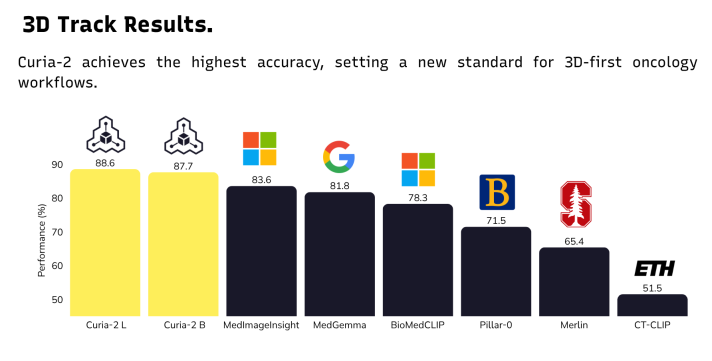
Building on Curia’s success, the project continues to leverage EuroHPC systems to build even more powerful and specialised models. This includes Curia-2, which improves the original’s self-supervised pre-training strategy and scales the architecture up to a billion-parameter model, a first for multi-modal CT and MRI foundation models.
Then there’s Curia-MAE, a model pre-trained on 300,000 CT and MRI volumes covering many anatomical sites. A natively 3D model, Curia-MAE is unique in that it can process the entire volume at once, a task that, although memory-heavy, unlocks more complex tasks like segmentation of structures.
Last but not least there’s Jolia, a 3D CT vision-language foundation model that connects images with text and opens the door to being able to draft reports for radiologists – a tedious task that takes up a substantial amount of a doctor’s time and is often cited as a key factor in radiologist burnout.
Trained on the EuroHPC JUPITER supercomputer, Jolia outperforms previous state-of-the-art models on findings classification, report generation and cross-centre transfer, and sets a new state-of-the-art on several public benchmarks.
To encourage further innovation, Raidium has made all its model weights available via Hugging Face.
AI made – and trained – in Europe
Raidium is demonstrating that sovereign medical AI trained using European data and on European infrastructure is both achievable and competitive. Furthermore, by leveraging Europe’s high-quality health data and supercomputing infrastructure to drive faster medical innovation and improve patient outcomes, the company’s work supports the European Commission’s designation of healthcare as a priority sector for accelerating industrial AI investment and deployment.
“Through initiatives like the EuroHPC JU, even a small European startup with only a few employees can build a foundational model for radiology that is competitive with – and in some cases better than – models from large US organisations,” says Dancette.
For companies thinking about pursuing access time on an EuroHPC supercomputer, Dancette says, ‘go for it’.
“The access process is well defined, the machines are competitive with the best commercial and enterprise cloud services, and they make it possible to perform large-scale training for open research,” concludes Dancette.
Find more information on how your research can benefit from EuroHPC supercomputing.