
Researchers can simulate the formation of massive black holes and galaxies in the early cosmos thanks to EuroHPC JU supercomputers. This is specifically important because using machine learning to reconstruct more accurate histories of black holes can help us gain a deeper understanding of the origins and evolution of our universe.
For the past four years, John Regan, a research fellow and associate professor at Ireland’s Maynooth University, has been using the EuroHPC supercomputers Karolina and MeluXina to model the formation and evolution of black holes.
This is particularly challenging work because black holes carry no ‘memory’ of their history, which makes it virtually impossible to deduce their age.
Instead, Professor Regan must run extensive simulations to figure this out, and EuroHPC JU provides the necessary infrastructure to do so.
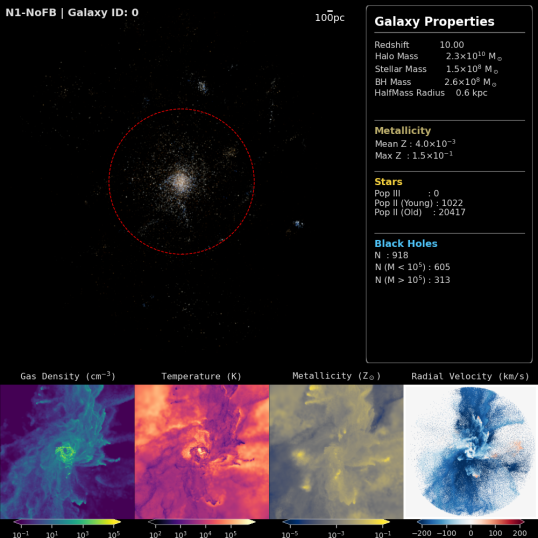
Modelling black hole formation with EuroHPC supercomputers
The computational models that this research project runs on are essential for interpreting the observations obtained from powerful telescopes like the James Webb Space Telescope (JWST).
JWST observations show that the early universe was full of massive black holes, far more than initially expected. To understand why, Professor Regan is using EuroHPC JU resources to run state-of-the-art simulations that model the first stages of black hole and galaxy formation in the early universe, essentially the first few hundred million years after the Big Bang.
One of those simulations is SEEDZ, which allows researchers to create virtual galaxies and black holes that can then be compared to what is observed in JWST data. “We’re taking the model and testing it against JWST results, which lets us know whether we’re interpreting the observations correctly,” says Professor Regan.
To illustrate, Professor Regan points to the bright galaxies he saw in JWST images. Although he believed that this brightness was caused by black holes within the galaxies, he couldn’t know for sure because one can’t actually see black holes.
To test this hypothesis, Professor Regan used SEEDZ to simulate the formation of very massive black holes in the early universe.
The SEEDZ model is designed to take account of gravity and gas dynamics, stars and black hole formation, and supernova explosions. Once the model is ready, it is just a matter of running the simulation forward in time and watching as the virtual universe forms and evolves and then comparing the result to the JWST observations.
“Observations are basically snapshots of galaxy formation, a process whose timeline far exceeds human lifetimes,” notes Professor Regan. “But with simulations, we get the full movie – we can ‘see’ the assembly of galaxies and black holes in our virtual universe.”
In the case of the very bright galaxies seen in the JWST observations, what the simulated universe showed was that growing black holes shine incredibly bright because the gas falling into them accelerates to tremendous speeds and becomes incredibly hot. If they become massive enough, these black holes can cause the galaxy to look very bright.
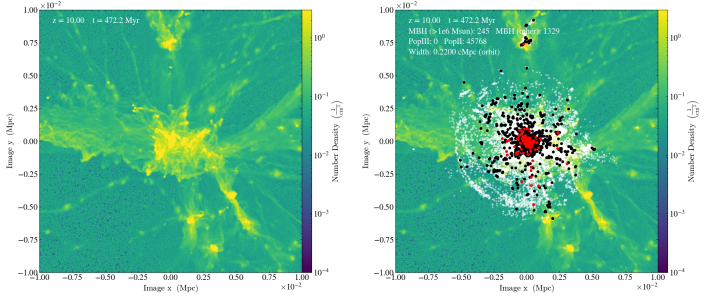
EuroHPC supercomputers light the way forward
The net result of Professor Regan’s work is a better understanding of the early days of the universe and how galaxies like our own emerged.
“While telescopes do a remarkable job at seeing galaxies, they can’t show us their histories,” says Professor Regan. “Our simulations allow us to see a galaxy’s origin story – and EuroHPC JU supercomputers make that possible.”
Despite the progress made, there’s still so much about our universe that remains a mystery – things like dark matter, dark energy and even the Big Bang itself. Luckily, researchers now have the observations, models and supercomputers they need to shine light on even the darkest corners of the universe.
“The models we are running on EuroHPC supercomputers and the results being produced are world-leading and point the way forward for future exploration,” concludes Professor Regan.
For Professor Regan, that future involves improving some of the details in his models while also leveraging the potentially massive advances in machine learning – steps that will likely see him once again using EuroHPC JU supercomputers.