

Best EuroHPC User Awards
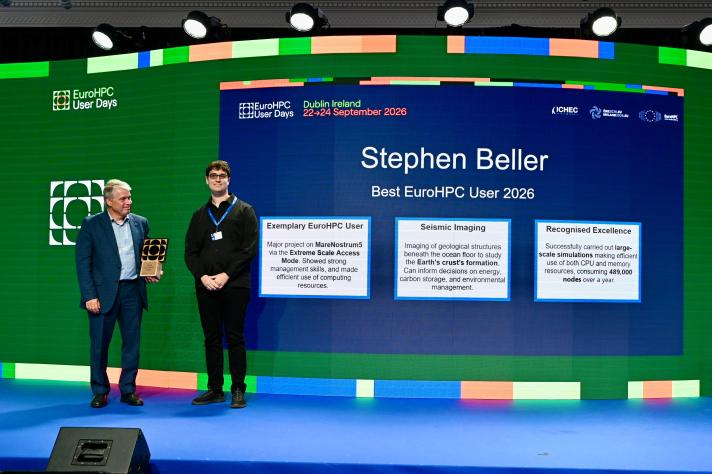
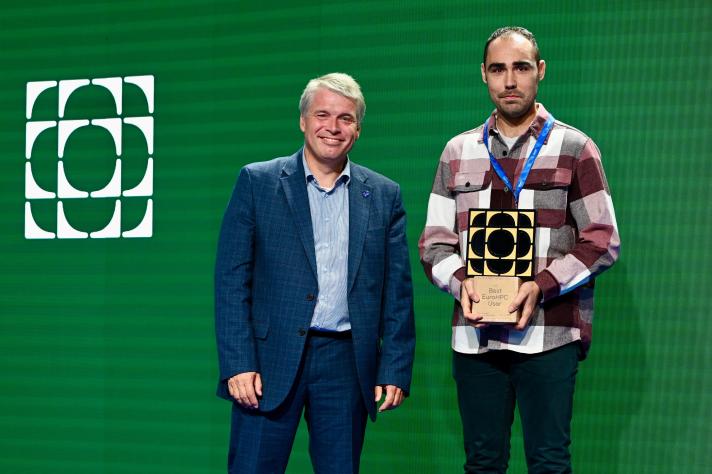
The 2026 Best EuroHPC User awards were presented to two users, Stephen Beller and Thomas Saillour. The selection of the laureates was made by the European supercomputing centres hosting and operating the EuroHPC supercomputers. The awards celebrate the users' strategic use of EuroHPC resources and their proficiency in optimising workloads on the machines.
Stephen Beller was chosen for his work on creating multiparameter pictures of the subsurface from multicomponent seabed seismic data using 3D elastic Full Waveform Inversion (FWI). Generating detailed images of the geological structures beneath the ocean floor helps researchers understand how the Earth's crust is formed and behaves. This research can support safer and more informed decisions about energy, carbon storage, infrastructure, and environmental management. To handle the complexity of simulating wave propagation using the spectral element method, the project was conducted on the MareNostrum5 GPP partition through the Extreme Scale Access call.
In the process, Stephen consumed 489,000 nodes over a year and successfully carried out large-scale simulations, achieving a particularly efficient use of both CPU and memory resources.
Thomas Saillour was also awarded EuroHPC Best User for his SeaReport project conducted through the Extreme Scale Access call and the Regular Access call. Making use of the MeluXina CPU and the MareNostrum5 GPP partitions, on which the team were allocated 160,000 and 240,000 node hours respectively, the project aims to advance the Joint Research Center’s global metocean modelling capabilities. It would enable the creation of more accurate 3D simulations and forecasts of storm surges and changes in water levels, helping coastal communities prepare for extreme weather events caused by climate change.
Throughout their work, Thomas and his team were shown to make particularly good usage of EuroHPC systems and had positive interactions with the teams of the centres hosting the supercomputers. They notably worked with EPICURE, an Application Support Team (AST), to create an optimised code making more efficient use of the supercomputer’s hardware resources.
Best Papers Awards
This year, two papers were recognised as Best Papers at the EuroHPC User Days 2026.
In the spring of 2026, users of the EuroHPC systems were invited to submit publications on projects making use of EuroHPC resources. A scientific review board then evaluated the submissions before selecting the papers to be presented in the Elsevier Procedia Computer Science of the EuroHPC User Days 2026 Book of Proceedings.
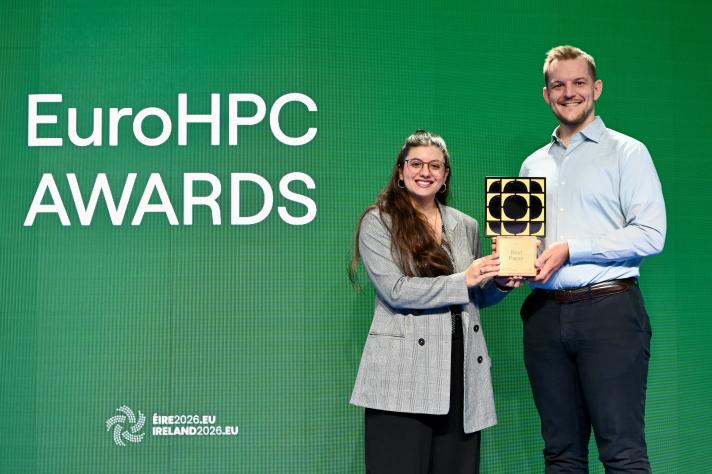
Carolina Oliveira Costa, formerly of the European Commission's Directorate-General for Translation, was awarded Best Paper for her submission "Mitigating Catastrophic Forgetting in Multilingual Continual Pretraining: Lessons from EU Institutional LLMs”. As Carolina has since moved to a new role outside the Commission and was unable to accept the award herself, Ilja Rausch, co-author and principal investigator for the project, accepted the award on behalf of the team.
The scientific review board selected the paper in recognition of its relevance to the needs of European Union (EU) institutions, its strong methodological approach, and the practical value of providing a guide to develop a multilingual large language model (LLM).
The paper explores how to improve EU Institutional LLMs by enabling them to support all 24 official EU languages. To that end, the team focused on reducing catastrophic forgetting, where a model loses previously learned capabilities as it learns new material. Their results revealed the challenges of balancing multilingual adaptation with high-resource language preservation.
The project was conducted on the Leonardo Booster supercomputer.
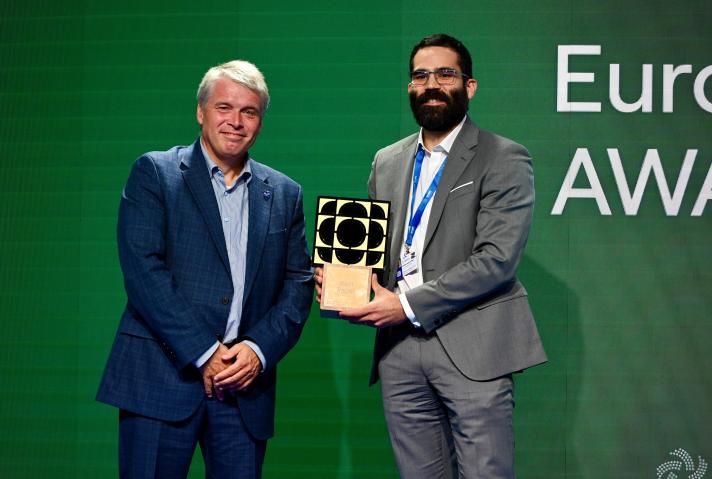
Dr. Rodrigo Bartolomeu, from the Julich Supercomputing Centre in Germany and part of the MultiXscale CoE was also awarded the Best Paper award for his submission "Scaling and performance aspects of the P3M method on multiple GPUs”.
The scientific review board selected this paper for its clear and strong contribution to making complex scientific simulations run faster and more efficiently on modern supercomputers.
The paper focused on a common problem in particle simulations: calculating how large numbers of charged particles affect each other over long distances, which can take a great deal of computing time. To address this, the team developed a flexible software library using the Ewald and P3M methods, designed to work efficiently on both CPUs and GPUs, including systems with multiple GPUs.
Their results showed that performance depends on finding the right balance between calculations and exchanging data between processors.
Computational experiments for the project were conducted on MareNostrum 5 Accelerated partition.
In congratulating the awardees, Anders Jensen, the EuroHPC JU Executive Director stated:
“These awards recognise the exceptional work of the researchers and teams behind these projects. Their achievements show how EuroHPC supercomputers can support scientific excellence and innovation and bring practical solutions to some of the most pressing issues of our time.”
Background
The fourth EuroHPC User Days took place between 22-24 September 2026 at the Clayton Hotel in Dublin, Ireland. With a participation of around 700 people, the most attended EuroHPC User Days so far, the event is an important moment in the year to engage with EuroHPC user communities and celebrate the successful research projects undertaken with the use of EuroHPC infrastructure. The EuroHPC User Days event is an annual opportunity for knowledge sharing, dissemination, and networking for EuroHPC users communities.
The proceedings of EuroHPC User Days 2024 and 2025 can be consulted on the dedicated page.
The EuroHPC JU is a legal and funding entity that brings together the European Union and participating countries to coordinate efforts and pool resources with the objective of making Europe a world leader in supercomputing.
To equip Europe with a cutting-edge supercomputing infrastructure, the EuroHPC JU has already procured 12 supercomputers, distributed across Europe.
European scientists and users from the public sector and industry can benefit from EuroHPC supercomputers via the EuroHPC Access Calls no matter where in Europe they are located, to advance science and support the development of a wide range of applications with industrial, scientific and societal relevance for Europe.
Currently, the EuroHPC JU is also overseeing the implementation of 19 AI Factories, across Europe, complemented by 13 AI Factory Antennas, which offer free, customised support to SMEs and startups.
Additionally, the EuroHPC JU is deploying a European Quantum Computing infrastructure, integrating diverse European quantum computing technologies with existing supercomputers.
The EuroHPC JU also funds research and innovation projects to develop a full European supercomputing supply chain, from processors and software to applications to be run on these supercomputers and know-how to develop strong European HPC expertise.
With the recent adoption of Council Regulation (EU) 2026/150, the EuroHPC JU’s mandate has been expanded with new action pillars dedicated to the deployment of AI Gigafactories across Europe and the advancement of quantum technologies.
- Publication date
- 23 September 2026
- Author
- European High-Performance Computing Joint Undertaking