
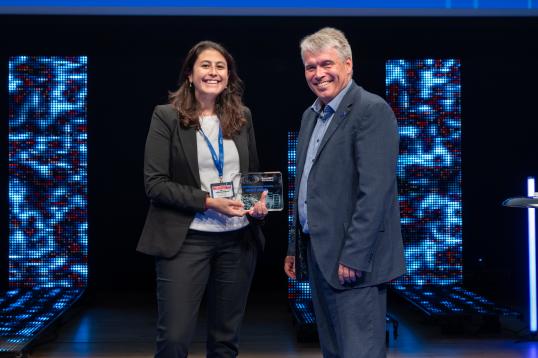
This month EuroHPC JU and Women in HPC have teamed up with our 2025 Best User, Valeria Ospina who tells us about her transition from physics to HPC. She shares advice for maximising access time and results on EuroHPC resources and her career experiences as a woman in HPC.
Learning to Think at Scale: From Physics Problems to Integrated Fusion Architectures
I did not set out to build a career in high-performance computing (HPC). I came to it through trying to solve physics problems that were simply too large, too coupled, and too unforgiving to be solved any other way. Over time, HPC stopped being “just a tool” and became a way of thinking: about systems, uncertainty, collaboration, and my own role as a scientist.
This blog is a reflection on what I have learned along the way as a heavy user of HPC systems, and as a scientist building a career in an ecosystem where access to opportunity, authority, and visibility is still unevenly distributed, but steadily improving.
From Isolated Physics Problems to Integrated Fusion Architectures
My background is in engineering, plasma physics, and kinetic modelling, working on problems related to laser–matter interaction and inertial fusion energy. Early in my training, I learned how to study specific physical phenomena in isolation: a given interaction regime, a given ion acceleration scheme, or a particular scaling law.
What HPC enabled was a transition from that isolated view to something much broader: the study of integrated fusion architectures. Instead of asking whether a piece of physics works under idealised conditions, HPC allows us to ask how different subsystems interact, where sensitivities lie, and which parameters truly matter when decisions must be made at the level of a facility, a program, or a startup.
This shift is profound. It turns hard physics concepts into actionable guidance, supporting consistent decision-making under technical, financial, and temporal constraints. HPC becomes not only a scientific instrument, but a bridge between physics understanding and strategic choices.
Insight at Scale: Discipline, Iteration, and Connections
Running large simulation campaigns taught me that scientific insight is rarely the product of a single “perfect run”. It emerges from connections: between parameters, between models, between diagnostics and between people. Sensitivity analyses, convergence studies, code optimisation, and iteration are where understanding is built.
HPC forces you to be explicit about assumptions, numerical limits, and trade-offs. It also enforces discipline. If a simulation workflow is fragile, unclear, or poorly documented, it will collapse as soon as you try to scale it, share it, or revisit it months later.
One of the most important lessons I learned as an HPC user is that technical clarity is a form of leadership. Well-structured input decks, reproducible workflows, and clear diagnostics are not just good practices. They are what allow teams to move faster, trust results, and build on each other’s work rather than re-deriving it from scratch.
HPC as a Collaborative Endeavor
Another misconception I had early on was that excellence in HPC was mostly about individual brilliance: knowing the right simulations, the right physics, the right tricks. In reality, large-scale computing is completely collaborative.
Progress depends on interactions with system administrators, supercomputer hosting entities, physics experts, and other users pushing systems in different directions. Learning how to ask good questions, report bugs clearly, and respect the constraints of shared infrastructure is as important as optimising performance. Over time, I became involved not only as a user, but also as a proposal writer, project lead, and mentor.
Writing HPC proposals taught me how to articulate scientific value under resource constraints. To be competitive, a proposal must align with the computing centre's mission, demonstrate clear scientific impact, and provide a compelling justification for the requested resources. A well-crafted proposal not only grants access to world-class computing power but enables ambitious ideas to become ambitious scientific programs. Taking the lead on simulation campaigns taught me how to translate physics questions into computational strategies that others can execute, extend, and improve.

Being a Woman in HPC
Being a woman in HPC has shaped my experience, but not always in the way people expect. While structural challenges remain and women are still underrepresented in many technical spaces, I have been genuinely encouraged by the number of women in leadership roles within the EuroHPC JU ecosystem. I have consistently found strong support, particularly from women who lead by example and actively create space for others to grow.
That support taught me something important about confidence. Confidence does not come out of thin air. It comes from understanding your merits, setting clear goals, and seeing your work evaluated seriously. In environments where rigor and impact are valued, good work tends to be noticed. Strong references, visible results, and sustained contributions help mitigate underrepresentation and make it easier to move forward based on what you deliver rather than how you are perceived.
Clear communication has been central to that journey. Making assumptions explicit, documenting decisions, and explaining reasoning carefully are not just technical habits; they are ways of ensuring that work speaks for itself and remains robust beyond the individual who produced it.
What HPC Taught Me About Careers
HPC shaped not only how I do science, but how I think about careers. Large-scale computing sits at the intersection of physics, engineering, software, and systems integration. Operating at that intersection is demanding, but also uniquely powerful.
Working in HPC environments prepared me to function at boundaries: between disciplines, between research depth and program-level decisions, and between long-term vision and near-term constraints. These are skills that extend far beyond supercomputers.
Perhaps the most important lesson is this: careers, like large simulations, are nonlinear systems. Progress is rarely monotonic. Small decisions compound. Initial conditions matter less than adaptability, clarity, and persistence.
Looking Forward
As HPC systems grow in scale and complexity, so do the responsibilities of those who use them. Efficiency, sustainability, reproducibility, and responsible use of shared resources are no longer peripheral concerns; they are central to scientific credibility.
For younger scientists, and especially for women entering HPC-heavy fields, my advice is simple but may be difficult to follow: invest in fundamentals, document your work, build networks deliberately, and do not wait for permission to take ownership of complex problems.
HPC gave me a way to reason beyond any single equation or experiment. More importantly, it taught me that the most impactful scientific progress emerges when technical rigor and human collaboration are treated as equally essential.
About the Author
Dr. Valeria Ospina Bohórquez is an engineer, plasma physicist, and senior scientist at Focused Energy, where she works on developing fusion technologies aimed at enabling clean energy in a decarbonised economy. Focused Energy is a laser fusion company building on the foundation established at the National Ignition Facility and pursuing one of the most promising paths toward clean, reliable fusion energy. In her current role, Valeria focuses on the development of integrated fusion architectures, combining large-scale high-performance computing and experimental facility design to translate fundamental plasma physics into system-level design decisions. She is an active user of EuroHPC JU infrastructures, leading and contributing to large simulation campaigns that span physics modelling, software development, and cross-disciplinary collaboration. Valeria is also engaged in mentoring and community-building efforts, with a particular interest in using HPC as a unifying layer between physics, engineering, and data-driven decision-making in fusion energy research.
- Publication date
- 11 February 2026
- Author
- European High-Performance Computing Joint Undertaking