

The latest editions of the TOP500 and Green500 lists were released today, on Tuesday 23rd June 2026, at the ISC 2026 event being held this week in Hamburg, Germany.
JUPITER remains among the world’s five most powerful supercomputers, while DAEDALUS and Arrhenius, two new mid-range systems located in Greece and Sweden made their first appearance in the TOP500, entering the Top 50 at 31st and 42nd place, respectively.
All other operational EuroHPC supercomputers are featured on the TOP500 list of the world’s most powerful systems, enabling breakthrough research and innovation every day.
JUPITER also remains the world's most energy-efficient exascale supercomputer, while the two new systems, DAEDALUS and Arrhenius, along with several other EuroHPC systems, rank highly in the Green500 list, underlining the EuroHPC JU's commitment to sustainable high-performance computing.
Two new entries
DAEDALUS, located in Attica Greece, at the Lavrion Technological and Cultural Park, is based on HPE’s NVIDIA GH200 direct liquid cooled architecture and operated by the National Infrastructures for Research and Technology (GRNET) under the auspices of the Hellenic Ministry of Digital Governance and Artificial Intelligence. With a performance of 85,69 petaflops, DAEDALUS enters the TOP500 at 31st position and is expected to become fully available to European users shortly.
Arrhenius is an HPE Cray EX-based system, hosted by Linköping University and operated by the National Academic Infrastructure for Supercomputing in Sweden (NAISS). For its first appearance on the TOP500 list, it holds 42nd place globally with 66,82 petaflops. European users can already access Arrhenius through the EuroHPC AI for science access call.
EuroHPC Supercomputers: Leading in Performance and Sustainability
JUPITER, hosted by the Jülich Supercomputing Centre (JSC) in Germany, is Europe’s first exascale supercomputer, able to perform more than 1 trillion (1,000,000,000,000,000,000) operations per second. JUPITER is built on BullSequana XH3000 architecture and equipped with approximately 24,000 NVIDIA GH200 Grace Hopper Superchips. Its architecture delivers unprecedented capability for both large-scale simulations and advanced AI workloads.
LUMI, operated by CSC in Finland with the LUMI consortium, ranks 11th. Built on HPE Cray EX architecture, LUMI delivers 379.7 petaflops of computing power, continuing to accelerate European research and innovation.
Leonardo, operated by CINECA in Italy and based on BullSequana XH2000 technology, holds 12th place globally with 241,2 petaflops.
MareNostrum 5, operated by the Barcelona Supercomputing Centre (BSC) in Spain, is ranked 16th with a performance of 175.3 petaflops in its accelerated partition, based on Eviden’s BullSequana XH3000 hybrid architecture. Its general-purpose partition, based on Lenovo’s ThinkSystem SD650 V3 technology and powered entirely by Intel Sapphire Rapids processors, is ranked 61st with a performance of 40.1 petaflops.
EuroHPC's other operational mid-range systems, Meluxina, Karolina, Discoverer, Deucalion, and Vega, all feature among the world's most powerful supercomputers.
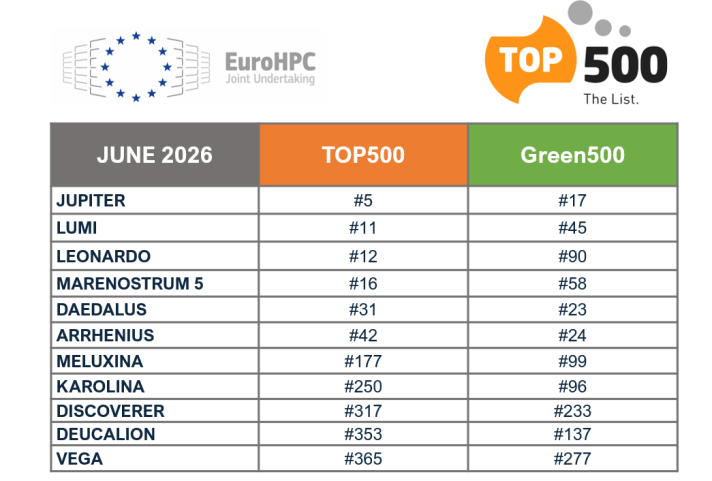
Another highlight of today’s publication is EuroHPC JU’s ongoing effort to procure green supercomputers, with several of its systems ranking highly on the Green500 list, a clear reflection of its strong focus on sustainable computing practices.
JUPITER is setting new standards in sustainability and stands out as the most energy-efficient exascale system worldwide, with its highly energy-efficient BOOSTER partition, capable of more than 63 thousand millions operations per watt. With its highly efficient warm water-cooling system, JUPITER is also designed to use the waste heat generated in operation to heat buildings and be integrated into the Jülich campus heating network.
DAEDALUS and Arrhenius ranked 23rd and 24th in the Green500 list, both with more than more than 61 thousand millions operations per watt.
LUMI placed 45th with over 53 billion operations per watt. Powered entirely by carbon-free hydroelectric energy, LUMI employs liquid cooling technology and channels waste heat into the local district heating network. Its data centre leverages northern Finland's naturally cool climate for free cooling, maximising energy efficiency.
MareNostrum 5, secured 58th place with over 48 billion operations per watt. Its advanced direct liquid cooling and energy-efficient design, combined with 100% green energy, demonstrate that sustainability and peak performance go hand in hand.
Background
The TOP500 list ranks the world’s 500 most powerful supercomputers according to their performance on the LINPACK Benchmark, while the Green500 list ranks them according to how many billions of operations a system can perform per watt of power consumed. Both lists are published twice a year and serve as essential benchmarks in the supercomputing community.
The EuroHPC JU is a legal and funding entity that brings together the European Union and participating countries to coordinate efforts and pool resources with the objective of making Europe a world leader in supercomputing.
The EuroHPC JU has already procured 12 supercomputers, located across Europe including JUPITER and Alice Recoque, Europe’s first exascale systems.
The scientific community and industry users all from Europe regardless of their location can access EuroHPC supercomputers via the EuroHPC Access Calls. This access allows them to speed up progress in technology, science and support the development of a wide range of applications that will benefit Europe.
Currently, the EuroHPC JU is also overseeing the implementation of 19 AI factories (AIF) across Europe, complemented by 13 AI Factory Antennas, to offer free, customised support to SMEs and startups.
Additionally, the EuroHPC JU is deploying a European Quantum Computing infrastructure, integrating diverse European quantum computing technologies with existing supercomputers.
The EuroHPC JU also funds research and innovation projects to develop a full European supercomputing supply chain, from processors and software to applications to be run on these supercomputers and know-how to develop strong European HPC expertise.
With the recent adoption of Council Regulation (EU) 2026/150, the EuroHPC JU’s mandate has been expanded with new action pillars dedicated to the deployment of AI Gigafactories across Europe and the advancement of quantum technologies.
- Publication date
- 23 June 2026
- Author
- European High-Performance Computing Joint Undertaking