

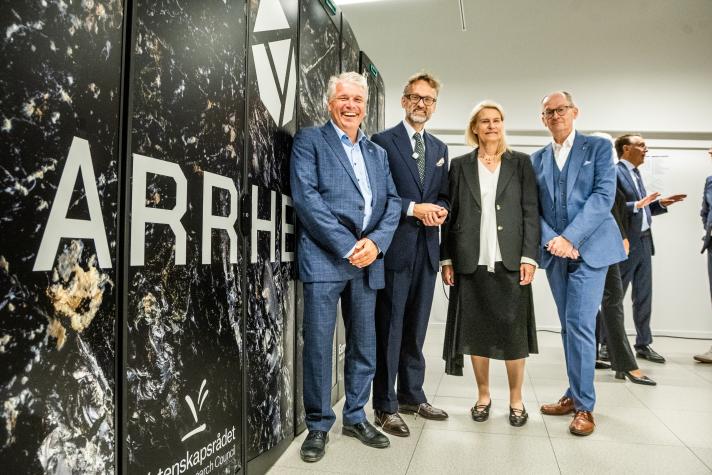
This world-class supercomputer was unveiled in Linköping University during a ribbon-cutting ceremony. The event was attended by Anders Dam Jensen, EuroHPC JU Executive Director, and Maria Nilsson, State Secretary to the Minister for Upper Secondary School, Higher Education and Research.
Anders Jensen, EuroHPC JU Executive Director stated:
“With the inauguration of Arrhenius, I am delighted to welcome a new mid-range supercomputer to our EuroHPC portfolio of HPC systems, marking another step towards enhanced European technological sovereignty. Arrhenius’ ability to carry out highly demanding computational tasks will allow our users to push boundaries in scientific and technological simulations, helping to drive breakthroughs in areas like drug discovery and climate change mitigation.”
About the Arrhenius Supercomputer
Arrhenius is a mid-range supercomputer capable of executing more than 60 petaflops, the equivalent of over 60 million billion operations per second. It ranked 42nd in the latest TOP500 list of the world’s most powerful supercomputers, published in June 2026. Designed to handle complex simulations and compute-intensive AI applications, it will enable simulations in areas such as climate modelling, materials science, life sciences, and engineering.
The machine will benefit a wide spectrum of users across Europe, including researchers, industries, and the public sector. Arrhenius's strong security and data integrity criteria make it perfect for private companies' proprietary product development and sensitive research involving personal data.
Arrhenius also combines high performance with energy efficiency. As part of the EuroHPC JU’s ongoing efforts to procure more energy-efficient supercomputers, the system delivers more than 61 billion operations per watt, placing it 24th in the latest Green500 list and highlighting its strong energy efficiency.
Through the EuroHPC AI for science access call, European users have already begun using Arrhenius ahead of its official inauguration, giving researchers early access to the new supercomputer. Arrhenius is now available to a wider range of users through the EuroHPC regular access call, as well as through the benchmark and development modes.
More details
The supercomputer was named after Carl Axel Arrhenius, a Swedish geologist and chemist who, in 1787, discovered the mineral gadolinite, which was later found to contain several unknown elements called rare earth elements.
The system was procured under a EuroHPC JU contract signed with HPE in July 2025.
The estimated total value for Arrhenius is EUR 68.5 million. It is co-funded up to 35% by the EuroHPC JU, with funding provided through the Digital Europe Programme (DEP) and contributions from the Swedish Research Council to NAISS.
The EuroHPC JU and NAISS, hosted by Linköping University, jointly manage access to compute resources on the new machine in proportion to their respective investments. To ensure an appropriate uptake by industry and public sector users, organisations like RISE, Research Institutes of Sweden, and ENCCS, the EuroCC National Competence Center Sweden, are also involved in the process.
Background
The EuroHPC JU is a legal and funding entity that brings together the European Union and participating countries to coordinate efforts and pool resources with the objective of making Europe a world leader in supercomputing.
To equip Europe with a cutting-edge supercomputing infrastructure, the EuroHPC JU has already procured 12 supercomputers, distributed across Europe.
European scientists and users from the public sector and industry can benefit from EuroHPC supercomputers via the EuroHPC Access Calls no matter where in Europe they are located, to advance science and support the development of a wide range of applications with industrial, scientific and societal relevance for Europe.
Currently, the EuroHPC JU is also overseeing the implementation of 19 AI Factories, across Europe, complemented by 13 AI Factory Antennas, which offer free, customised support to SMEs and startups. One of these is the Sweden AI Factory, formerly known as the Mimer AI Factory. The Sweden AI Factory will provide a mid-range AI-dedicated supercomputer that will prioritise cloud-style access mechanisms and large-scale storage for sensitive data. It will build AI support and training expertise in life sciences and healthcare, material sciences, autonomous systems and the gaming industry, all of which are areas of strength in Europe in general and Sweden in particular.
Additionally, the EuroHPC JU is deploying a European Quantum Computing infrastructure, integrating diverse European quantum computing technologies with existing supercomputers.
The EuroHPC JU also funds research and innovation projects to develop a full European supercomputing supply chain, from processors and software to applications to be run on these supercomputers and know-how to develop strong European HPC expertise.
With the recent adoption of Council Regulation (EU) 2026/150, the EuroHPC JU’s mandate has been expanded with new action pillars dedicated to the deployment of AI Gigafactories across Europe and the advancement of quantum technologies.
- Publication date
- 8 September 2026
- Author
- European High-Performance Computing Joint Undertaking