

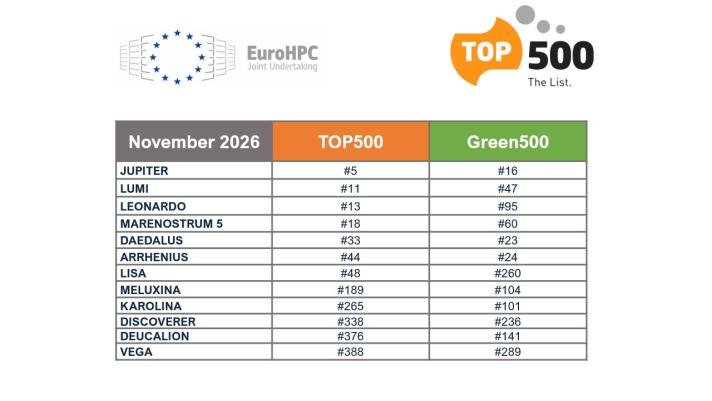
The 2026 November edition of the TOP500 and Green500 rankings, released today at Supercomputing Conference (SC) in Chicago (US), provide an overview of the performance and global standing of all EuroHPC JU's operational supercomputers. The arrival of Alice Recoque in 2027, the second European exascale system, will further strenghten this infrastructure, marking another important milestone in the development of Europe's HPC capabilities.
EuroHPC supercomputers maintain a strong presence in global rankings
The 68th edition of the TOP500 and Green500 lists confirm the continued strong presence of EuroHPC supercomputers in the global landscape. Once again, all operational EuroHPC supercomputers feature in the TOP500 ranking, with several systems amongst the world's most powerful computing infrastructures. Several EuroHPC systems are also well ranked in the Green500 list, highlighting the focus on energy efficiency across the infrastructure.
All EuroHPC systems continue to support cutting-edge research and innovation across all EuroHPC Participating States.
JUPITER remains the highest-ranked EuroHPC supercomputer, securing 5th place in the TOP500 and maintaining its position among the world's 10 most powerful systems.
Making its first appearance in the TOP500 ranking, LISA (Leonardo Improved Supercomputing Architecture) has secured the 48th place, with a performance of 56.88 petaflops. Hosted and operated by CINECA in Bologna (Italy), LISA is the first EuroHPC computing partition designed specifically for AI workloads. Its AI-optimised infrastructure features 1,328 GPUs, expanding Leonardo's AI capacity.
Looking ahead: Alice Recoque, Europe's second exascale system in 2027
Beyond the systems currently featured in the rankings, EuroHPC JU is continuing to expand Europe's advance computing capabilities, with the next generation of infrastructure taking shape.
Designed to bring together HPC, artificial intelligence (AI) and quantum computing, EuroHPC JU's Alice Recoque exascale system will provide European research and innovation communities with new computing capabilities.
The supercomputing centre TGCC in France has completed preparations to host Europe's second exascale system. Its installation will take place in several stages, with the first computing racks expected to arrive at TGCC in 2027.
EuroHPC JU signed the contract with Bull in November 2025. The Jules Verne consortium brings together GENCI as Hosting Entity, CEA as Hosting Site and European partners including SURF (Netherlands) and GRNET (Greece). The consortium is also coordinating activities to ensure that the system is ready to serve Europe's scientific and research communities.
Alongside the development of its supercomputing infrastructure, EuroHPC JU is also strengthening Europe's computing capabilities through its growing network of AI Factories and AI Factory Antennas across Europe.
Building the European HPC, AI and quantum ecosystem
In 2026, EuroHPC JU's mandate was expanded to include the deployment of AI Gigafactories and the development of quantum technologies, following the entry into force of an amendment to the EuroHPC Regulation in January. This broader mandate was accompanied by a series of new investments and initiatives.
EuroHPC JU signed six contracts for AI-optimised supercomputers: the MareNostrum 5 AI upgrade in Spain, HammerHAI in Germany, the Sweden AI Factory, IT4LIA AI in Italy, MeluXina-AI in Luxembourg and LUMI-AI in Finland. In July, it also launched the call for tenders to establish AI Gigafactories.
Alongside these investments, EuroHPC JU continued to strengthen cooperation and access across the European computing ecosystem. In this context, it launched the first release of the EuroHPC Federation Platform, providing researchers, businesses and public sector organisations with a single access point to EuroHPC systems, and a call to enhance cooperation among AI Factories and AI Factory Antennas, with the resulting project expected to become operational in 2027.
The new EuroTPC project, led by the Barcelona Supercomputing Center, advanced the work on AI for science. In parallel, the EUMaster4HPC programme entered a new phase covering 2026–2032, continuing its work to develop advanced HPC skills across Europe.
Progress was also made in quantum computing and the wider supercomputing infrastructure. EuroHPC JU launched four calls for quantum technologies, followed by six additional calls covering quantum computing, communications, testing infrastructure and pilot lines. It also opened a pilot access call for its quantum computers, initially including Euro-Q-Exa, Piast-Q, VLQ, Lucy and Ruby.
In the infrastructure side, two new mid-range supercomputers were inaugurated: Arrhenius in Sweden, operated by NAISS, and DAEDALUS in Greece, from GRNET.
More recently, Canada became the 39th participating state of EuroHPC JU at the EU–Canada Summit in Montréal in October, further extending the international reach of the initiative.
Background
The EuroHPC JU is a legal and funding entity that brings together the European Union and participating countries to coordinate efforts and pool resources with the objective of making Europe a world leader in supercomputing.
With the recent adoption of Council Regulation (EU) 2026/150, the EuroHPC JU’s mandate has been expanded with new action pillars dedicated to the deployment of AI Gigafactories across Europe and the advancement of quantum technologies.
To equip Europe with a cutting-edge supercomputing infrastructure, the EuroHPC JU has already procured 12 supercomputers, distributed across Europe. The EuroHPC JU is also overseeing the implementation of 19 AI Factories across Europe, complemented by 13 AI Factory Antennas, which offer free, customised support to SMEs and startups.
Additionally, the EuroHPC JU is deploying a European Quantum Computing infrastructure, integrating diverse European quantum computing technologies with existing supercomputers. In 2027, the Exascale computer, Alice Recoque, will be inaugurated in France. An additional 19 AI Factories are being procured across Europe.
The EuroHPC JU also funds research and innovation projects to develop a full European supercomputing supply chain, from processors and software to applications to be run on these supercomputers and know-how to develop strong European HPC expertise.
European scientists and users from the public sector and industry can benefit from this European HPC, AI and Quantum computing infrastructure via the EuroHPC Access Calls, regardless of where they are located in Europe, to advance science and support the development of a wide range of applications with industrial, scientific and societal relevance for Europe.
- Publication date
- 16 November 2026
- Author
- European High-Performance Computing Joint Undertaking